
Filed under
Deliver toE-commerce, fulfillment and store operations leads at retailers and brands
One inventory for store, DC and online orders
When stores, a website and marketplaces sell from the same stock, one question comes up all day: can we promise this unit? The answer is only as good as the inventory record behind it.
Check a carton's billable weightsolutions / omnichannel-fulfillment
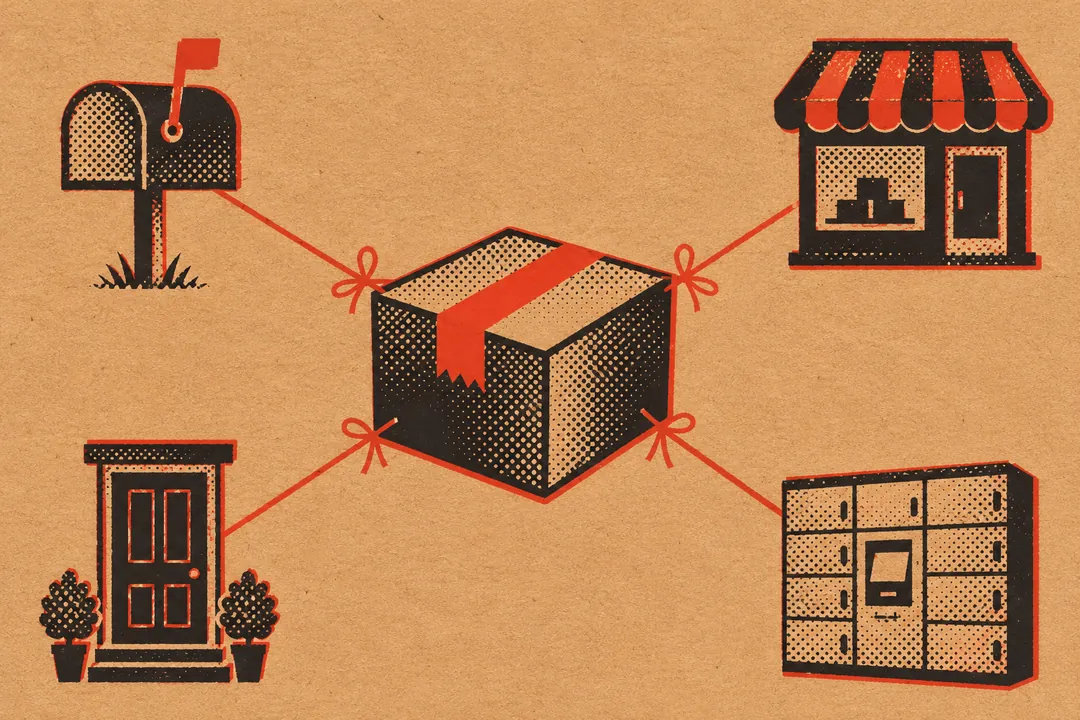
Selling through stores, a website and marketplaces from more than one stock location turns inventory into a promise. Every order asks the same two questions: is this unit available, and where should it ship from? The answer depends on one inventory record that store, DC and online orders all draw from, and on that record being right. We build the inventory, tracking and labeling pieces that your e-commerce platform, order management system and POS leave to spreadsheets and phone calls.
One inventory for every order source
Store stock is the usual weak point. A store sells the last unit at the register while the website still shows it, or a count is days old when an online order is routed there. What we typically build:
- An availability calculation by location and channel: on hand, less what is already allocated, less a buffer you set per channel or item.
- Reservations at order time, so two channels cannot promise the same unit.
- Routing rules and an exception queue for orders a location cannot fill, with a re-route to the next location by rule instead of by phone.
- Store cycle counts aimed at the items online customers buy most, because those records carry the most promises. The cycle count planner helps size the work.
Parcel tracking in one vocabulary
Each parcel carrier’s tracking API reports events in its own codes. We build the interface to your carriers’ tracking APIs and map their events to a short list of milestones: label created, picked up, in transit, out for delivery, delivered and exception. Customer emails, the help desk and your own reports then use the same words. Exceptions become rules with an owner, such as “no carrier scan by the end of the next business day after the label was printed”. The tracking milestone map is a template for that list, and shipment tracking software describes the build.
Dimensional weight starts at the packing station
Parcel charges follow carton size as much as weight. UPS and FedEx calculate dimensional weight as length times width times height, in inches, divided by 139. At UPS, 139 is the divisor for Daily Rates; Retail Rates use 166. Both carriers round every fraction of an inch up to the next whole inch, and every fraction of a pound up to the next whole pound. FedEx bills the greater of the actual weight and the dimensional weight.
A worked case: a carton measuring 12.2 by 10.1 by 8.4 inches is measured as 13 by 11 by 9. That is 1,287 cubic inches. Divided by 139 it is 9.26, which rounds up to 10 pounds. If the contents weigh 4 pounds, the billable weight under the FedEx rule above is still 10.
So the carton choice and the measurement both matter. We build carton selection rules at pack-out, dimension capture on every parcel record (from a dimensioner or from validated carton codes), and a report that compares the billed weight on carrier invoices with what you measured. You can check your own cartons with the dimensional weight calculator.
2D barcodes at the point of sale
GS1 US describes Sunrise 2027 as “a global transition from 1D UPC barcodes to 2D barcodes, like QR codes”, meant to help retailers make sure their POS systems can read and process those codes. For brands, GS1 US advises updating existing QR codes to GS1 Digital Link standards and including the product’s GTIN. GS1 Digital Link encodes identifiers such as the GTIN together with data such as batch numbers, serial numbers and expiry dates.
For an omnichannel operation, this touches four places we cover in requirements:
- POS and store scanners: can they read a 2D code and pass the GTIN to the POS software?
- Item master: is the GTIN recorded at each packaging level you sell and receive?
- Labels on your own-brand goods: what goes into the 2D code, and who maintains the web address behind it?
- Receiving: do you want to capture lot or expiry from 2D codes when they are present?
Label and scanning work is covered under barcode and RFID labeling.
Returns
Returns arrive at stores, at the DC by mail, and sometimes at a returns processor. Each one needs an order lookup, a reason, a condition grade and a disposition: restock, refurbish, sell as open box, return to vendor or dispose. We build return authorization, scan-in at the receiving point, grading and disposition steps that put sellable units back into available stock at the right location, and the message that tells the order system to issue the refund.
Example (fictional). An outdoor-gear brand ships from one DC and two stores. Its website shows item EX-30542, a two-person tent, in stock at a store, but the last unit sold at the register that morning and store sales post to inventory overnight. The written requirement becomes: “A POS sale reduces store availability within five minutes. For items with fewer than five on hand, the store holds back one unit from online orders. An online order a store cannot fill is re-routed to the DC within 15 minutes.” The acceptance test sells the last unit at the register, places an online order for it, and checks that the order routes to the DC.
Where to start
A Scope and plan engagement maps your order sources, stock locations, carriers and return paths, and writes requirements with acceptance tests for each. If parcel cost is the first concern, start by measuring a sample of your cartons against what the carriers billed. If availability is the first concern, start with store accuracy on your top online items. Either way, the inventory management software and tracking work that follows is planned in phases, so the first change reaches the floor before the whole program is built.
Scope your project.
Tell us what you need to track, which systems you run and when it has to work. We reply with questions or a time to talk.